
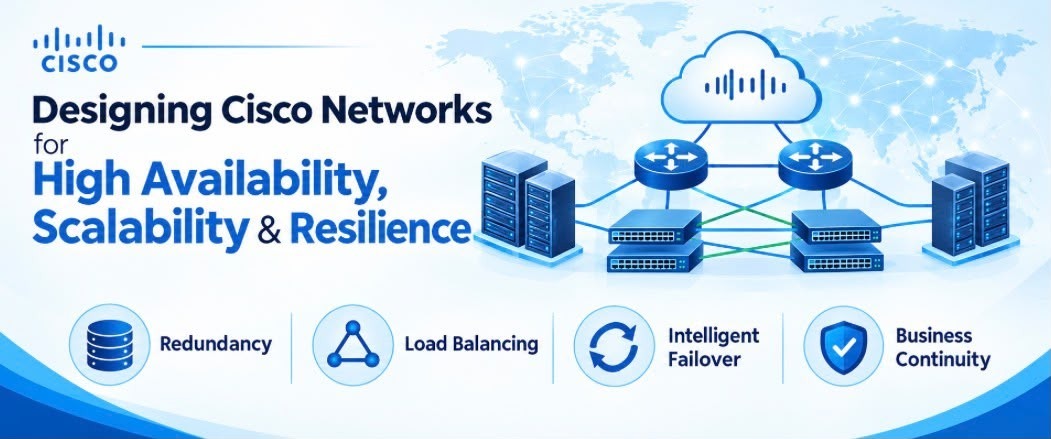
How Can Cisco Networks Be Designed for High Availability, Scalability, and Resilience?
Introduction
Enterprise networks must remain available while supporting increasing numbers of users, applications, devices, and sites. A well-designed Cisco network therefore needs more than connectivity. It should be able to tolerate component failures, grow without major redesign, and recover quickly when a problem occurs.
High availability, scalability, and resilience are closely related but describe different design goals. High availability focuses on keeping services accessible, scalability focuses on supporting growth, and resilience focuses on continuing or restoring operations when failures occur.
What Is High Availability?
High availability means designing network services so that the failure of a device, link, power source, or other component does not unnecessarily interrupt service.
Cisco network designs can improve availability through redundant devices, redundant links, first-hop redundancy, dynamic routing, and appropriate failover mechanisms.
What Is Scalability?
Scalability is the ability of a network to grow while maintaining manageable operations and predictable performance. A scalable design should accommodate additional users, switches, branches, applications, and traffic without requiring a complete architectural redesign.
• Hierarchical network architecture
• Modular design
• Summarization where appropriate
• Consistent addressing and naming
• Centralized management and automation
• Appropriate capacity planning
What Is Network Resilience?
Resilience is the ability of a network to withstand disruptions and continue providing essential services or recover them quickly. Resilience combines redundancy, failure detection, alternate paths, operational procedures, and recovery planning.
A resilient network assumes that failures will occur and is designed so that individual failures have limited impact.
- Use Redundancy at Critical Points
Redundancy is one of the most important building blocks of high availability. Critical network components should not depend on a single device or link when an outage would have a significant business impact.
• Redundant core or distribution switches
• Multiple uplinks from access switches
• Dual power supplies where supported
• Redundant WAN or Internet connections
• Multiple paths between critical network segments
Redundancy should be designed carefully so that the backup path or device is actually capable of carrying the required traffic during a failure. - Use First-Hop Redundancy
Hosts commonly use a default gateway to reach destinations outside their local subnet. If that gateway is a single device, its failure can interrupt connectivity for the attached clients.
Cisco environments can use first-hop redundancy technologies such as Hot Standby Router Protocol (HSRP) to provide a virtual default gateway. If the active device fails, another device can assume the gateway role according to the configured design.
The goal is to prevent a single first-hop device from becoming a single point of failure. - Build Redundant Paths with Dynamic Routing
Dynamic routing protocols can provide alternate paths when a link or router fails. Technologies such as OSPF and BGP can calculate or select alternative routes based on the network design and routing policy.
A resilient routing design should avoid unnecessary single-path dependencies and should ensure that alternate paths have appropriate capacity and routing behavior. - Design a Hierarchical and Modular Network
A hierarchical network separates functions into logical layers or modules. Traditional campus designs commonly use access, distribution, and core functions, while modern architectures may use different combinations depending on the environment.
Modularity makes it easier to expand a network, isolate failures, and standardize configurations. Changes in one part of the network can also be less disruptive when the architecture is properly segmented. - Use Link and Device Redundancy
Redundant physical links can improve both availability and capacity. Technologies such as EtherChannel can combine multiple physical links into a logical connection and provide link-level resilience.
If one physical member fails, the remaining members can continue carrying traffic, subject to the capacity and configuration of the bundle. - Plan for Capacity and Growth
A scalable network needs capacity planning. Engineers should consider current utilization as well as expected growth in users, devices, applications, and traffic.
• Interface bandwidth
• Switching and routing capacity
• Wireless capacity where applicable
• WAN bandwidth
• IP addressing requirements
• Device resource utilization
• Growth in application traffic
Capacity planning helps prevent a network from becoming a bottleneck as the organization grows. - Use Load Balancing Where Appropriate
Load balancing can distribute traffic across multiple available resources. At the network layer, multiple equal-cost paths may allow routing protocols to forward traffic over more than one path when supported by the design.
Load balancing should be combined with appropriate monitoring so that failed paths are removed or avoided when necessary. - Use Intelligent Failure Detection and Fast Convergence
A resilient network needs to detect failures quickly and react appropriately. Routing protocols, link-state mechanisms, tracking features, and other platform capabilities can help identify changes in network conditions.
Fast convergence should be balanced against stability. Aggressive timers or poorly designed failure-detection mechanisms can create unnecessary route changes or instability. - Segment the Network
Segmentation can reduce the impact of failures and security incidents. VLANs, routing boundaries, VRFs, and other segmentation mechanisms can separate traffic according to business, security, or operational requirements.
A well-segmented network can also make troubleshooting easier because problems can be isolated to a smaller portion of the infrastructure. - Use Centralized Management and Automation
As a network grows, managing every device manually becomes increasingly difficult. Centralized management platforms and automation can help standardize configurations, monitor devices, and apply changes consistently.
Automation can also reduce configuration errors and make large-scale changes more repeatable. - Design for WAN and Internet Resilience
Enterprise organizations may depend on WAN and Internet connectivity for cloud applications, remote offices, SaaS platforms, and business-critical services.
Resilience can be improved through multiple providers, diverse physical paths, redundant edge devices, and technologies such as SD-WAN where appropriate.
• Multiple WAN links
• Provider diversity where justified
• Redundant edge routers or firewalls
• Application-aware path selection
• Backup connectivity for critical locations - Protect Critical Network Services
High availability also applies to services that support the network. DNS, DHCP, authentication, monitoring, logging, and management systems can become critical dependencies.
Where business requirements justify it, these services should have appropriate redundancy and recovery mechanisms so that a failure does not affect the entire network. - Monitor the Network Continuously
A resilient design requires visibility. Monitoring helps engineers identify degraded links, resource exhaustion, device failures, routing changes, and unusual traffic patterns before they become larger incidents.
• Interface utilization and errors
• Device CPU and memory
• Link and device availability
• Routing neighbor status
• Latency and packet loss
• Environmental and power conditions
• Configuration and operational changes - Test Failover and Recovery
Redundancy should not be assumed to work simply because backup components are installed. Organizations should test failover mechanisms in a controlled manner. - Identify critical failure scenarios.
- Document the expected failover behavior.
- Test during an appropriate maintenance window.
- Verify that traffic uses the intended backup path or device.
- Measure recovery time and service impact.
- Document the results and correct any design gaps.
- Maintain Documentation and Operational Procedures
Network resilience depends on people and processes as well as technology. Up-to-date diagrams, IP addressing information, device inventories, configuration standards, and recovery procedures help engineers respond effectively during an incident.
Change management and configuration backups are also important because a technically redundant network can still experience prolonged outages if recovery information is unavailable.
A Practical Cisco Network Design Model
A simplified resilient enterprise design can combine several of these principles:
Internet / WAN
/
Edge 1 Edge 2
\ /
Redundant Core
/
Distribution / Services
/
Access Switches Access Switches
| |
Endpoints Endpoints
Benefits of a High-Availability, Scalable, and Resilient Design
• Reduced impact from individual device or link failures
• Improved service continuity
• Easier network expansion
• Better use of available network paths
• More predictable operational processes
• Faster detection and recovery from failures
• Improved support for business-critical applications
Common Design Considerations
No single architecture is appropriate for every organization. The right design depends on application requirements, traffic patterns, geographic distribution, security requirements, budget, service-provider options, and operational capabilities.
Engineers should evaluate redundancy against the actual business requirements. Adding redundant components everywhere can increase complexity and cost, while insufficient redundancy can create unacceptable single points of failure.
Conclusion
Designing a Cisco network for high availability, scalability, and resilience requires a combination of redundancy, modular architecture, dynamic routing, capacity planning, monitoring, automation, and tested recovery procedures.
The key objective is to build a network that can continue delivering important services when individual components fail and can grow as business requirements change. By identifying critical dependencies and designing appropriate backup paths, organizations can create networks that are easier to operate, expand, and recover.

You may also like
How Do DHCP Snooping and Dynamic ARP Inspection Protect Layer 2 Networks?