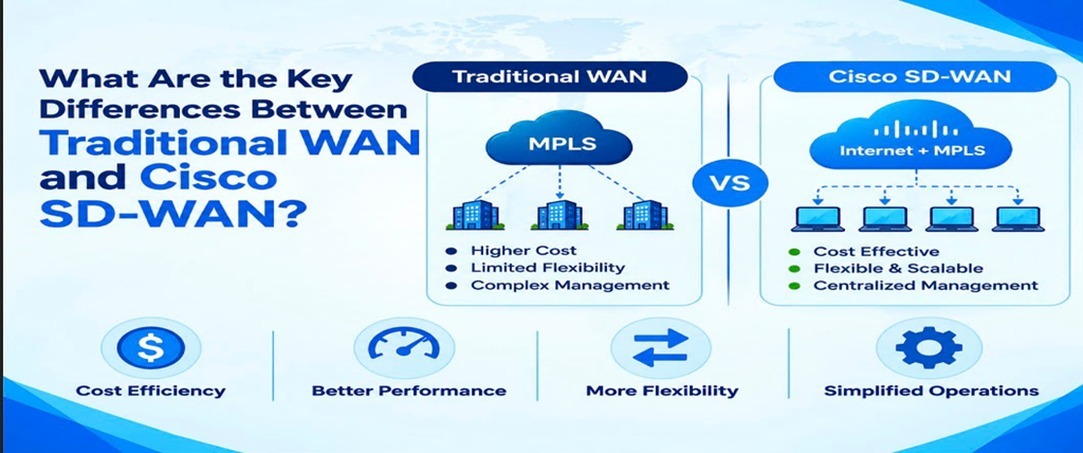
What Are the Key Differences Between Traditional WAN and Cisco SD-WAN?
Introduction
Wide Area Networks (WANs) connect users, branch offices, data centers, cloud environments, and applications across geographically distributed locations. Traditional WAN architectures have commonly relied on private connectivity such as MPLS, along with manually configured routers and centralized operational processes.
As organizations adopt cloud applications, remote work, and multiple connectivity options, software-defined WAN (SD-WAN) provides a different approach. Cisco SD-WAN uses centralized management, software-defined policies, and multiple transport options to simplify WAN operations and provide greater control over application traffic.
What Is a Traditional WAN?
A traditional WAN typically uses dedicated network services, such as MPLS, to connect branch offices and other locations. Routing decisions are generally configured on individual network devices, and changes may require device-by-device configuration or coordination with service providers.
Traditional WANs can provide predictable connectivity and established operational models, but adding locations or changing connectivity can require significant planning and manual work.
What Is Cisco SD-WAN?
Cisco SD-WAN is a software-defined WAN architecture that separates centralized control and policy management from the underlying WAN transports. It can use multiple types of connectivity, including MPLS, broadband Internet, and other supported transports.
Cisco SD-WAN provides centralized orchestration and policy capabilities that allow organizations to manage WAN infrastructure and application-aware traffic policies from a central management platform.
Key Differences Between Traditional WAN and Cisco SD-WAN
The main differences can be understood across connectivity, management, routing, application awareness, scalability, and operational efficiency.
- Connectivity Options
Traditional WAN:
Traditional designs often depend heavily on private WAN services such as MPLS. Internet links may be used, but the architecture and policies can vary by organization.
Cisco SD-WAN:
Cisco SD-WAN can use multiple transport types, allowing organizations to combine MPLS, broadband Internet, and other supported links according to their requirements. - Network Management
Traditional WAN:
Configuration and troubleshooting are commonly performed on individual routers or through a collection of device-management systems. Large changes can therefore require substantial manual effort.
Cisco SD-WAN:
Centralized management allows administrators to define and apply policies across many WAN devices. This can make configuration, monitoring, and operational changes more consistent. - Routing and Traffic Control
Traditional WAN:
Traffic forwarding is typically controlled through conventional routing protocols, static routes, and device-level configuration.
Cisco SD-WAN:
Cisco SD-WAN uses centralized policy and software-defined control to influence how traffic uses available WAN paths. Policies can be designed around application requirements, link conditions, and business objectives. - Application-Aware Networking
Traditional WAN routing generally focuses on network reachability and path selection. Application requirements may require additional configuration and monitoring.
Cisco SD-WAN provides application-aware capabilities that can identify traffic and apply policies based on application requirements. For example, an organization may configure policies to prioritize important business applications over less critical traffic. - Cost Considerations
Traditional WAN deployments that rely heavily on private circuits such as MPLS can involve higher recurring connectivity costs, particularly across many branch locations.
Cisco SD-WAN can use lower-cost Internet connectivity alongside private links where appropriate. This provides organizations with more options when designing connectivity, although actual costs depend on providers, locations, bandwidth, hardware, licensing, and operational requirements. - Scalability
Traditional WANs can scale to large environments, but adding branches and changing configurations may involve substantial manual coordination.
Cisco SD-WAN is designed to support centralized management and policy distribution across many sites. This can simplify the process of onboarding and managing a growing number of locations. - Security
Security architecture differs between traditional WAN and SD-WAN deployments. Traditional WANs may use dedicated security appliances and network controls at individual locations.
Cisco SD-WAN includes security capabilities and can integrate with Cisco security technologies. Organizations can use centralized policies and segmentation features to control traffic between branches, data centers, cloud environments, and other network zones. - Network Visibility
Traditional WAN:
Visibility may depend on separate monitoring systems, device logs, and individual network-management tools.
Cisco SD-WAN:
Centralized management and telemetry can provide a consolidated view of WAN devices, links, applications, and network performance, depending on the deployed Cisco SD-WAN components and licensing. - Cloud Connectivity
Traditional WAN architectures were often designed around data-center-centric traffic flows. As applications moved to public and private clouds, organizations increasingly needed more direct and flexible cloud connectivity.
Cisco SD-WAN can support cloud-oriented WAN designs and application-aware policies, helping organizations manage connectivity between branches, data centers, SaaS applications, and cloud environments.
How Cisco SD-WAN Works at a High Level
A simplified Cisco SD-WAN architecture includes branch devices, WAN transports, centralized management, and policy control. - WAN edge devices are deployed at branch or other network locations.
- The devices establish secure connections across available WAN transports.
- Centralized management provides configuration and policy information.
- The network evaluates available paths and applies configured policies.
- Traffic is forwarded using the selected path according to the policy and network conditions.
Traditional WAN vs Cisco SD-WAN: Summary
• Traditional WAN often relies on established private WAN services and device-level configuration.
• Cisco SD-WAN can combine multiple WAN transports under software-defined policy control.
• Traditional WAN changes may require more manual device-by-device operations.
• Cisco SD-WAN provides centralized management and policy distribution.
• Cisco SD-WAN can provide application-aware traffic policies.
• SD-WAN can offer additional connectivity flexibility for branch and cloud environments.
When Organizations Consider SD-WAN
Organizations may consider an SD-WAN architecture when they need to connect many branches, use multiple WAN transports, improve centralized management, support cloud applications, or apply consistent application and security policies across geographically distributed sites.
The appropriate architecture depends on factors such as existing infrastructure, application requirements, service-provider availability, security requirements, performance objectives, and total cost.
Conclusion
Traditional WAN and Cisco SD-WAN can both provide reliable connectivity between geographically distributed locations, but they use different approaches to management and traffic control. Traditional WAN designs commonly rely on established private connectivity and device-level routing configuration, while Cisco SD-WAN introduces centralized management, software-defined policies, multiple transport options, and application-aware capabilities.
Understanding these differences helps network teams evaluate how WAN architecture can support branch connectivity, cloud adoption, application performance, scalability, and operational requirements.