What Is SD-WAN and How Does It Transform Modern Networking?
Modern businesses depend heavily on reliable network connectivity to support cloud applications, remote employees, branch offices, data centers, and digital services. As organizations become increasingly distributed, traditional Wide Area Network (WAN) architectures can become complex to manage and may not provide the flexibility required by modern applications.
This is where Software-Defined Wide Area Networking (SD-WAN) plays an important role.
SD-WAN is transforming the way organizations design, manage, and operate their wide area networks. By introducing centralized management, intelligent traffic routing, automation, and application-aware policies, SD-WAN provides a more flexible approach to enterprise connectivity.
What Is SD-WAN?
SD-WAN stands for Software-Defined Wide Area Network.
It is a networking technology that uses software-based policies and centralized control to manage connectivity across geographically distributed locations.
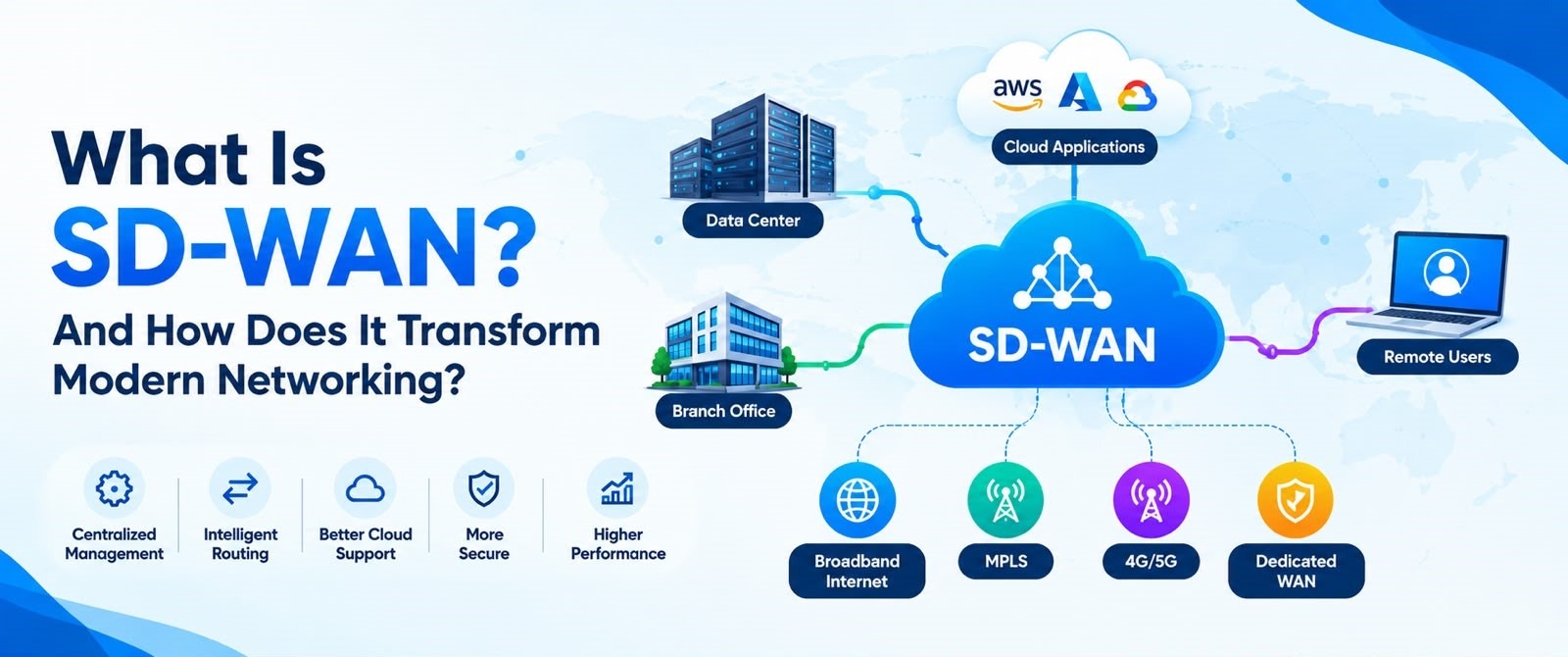
An SD-WAN architecture can connect branch offices, data centers, cloud environments, and remote users through multiple types of network connections, including:
• Broadband internet
• MPLS
• 4G and 5G networks
• Dedicated WAN connections
Instead of relying on a single connection or manually managing individual network devices at every location, SD-WAN enables organizations to manage their WAN infrastructure through a centralized platform.
How Does SD-WAN Work?
SD-WAN creates an intelligent network overlay across the underlying WAN infrastructure. It uses centralized policies to control how traffic moves between different locations and applications.
The technology continuously evaluates network conditions and can consider factors such as:
• Latency
• Jitter
• Packet loss
• Link availability
• Application requirements
Based on predefined policies and current network conditions, SD-WAN can select an appropriate path for different types of traffic.
For example, a video conferencing application may require a low-latency connection, while software updates may tolerate a slower connection. SD-WAN can apply different traffic policies based on these requirements.
This application-aware approach helps organizations use their available network resources more efficiently.
How Does SD-WAN Transform Modern Networking?
- Centralized Network Management
Traditional WAN environments often require administrators to configure devices individually at different locations. As organizations grow, managing these distributed devices can become increasingly complex.
SD-WAN provides centralized management, allowing administrators to configure policies, monitor performance, and manage multiple locations through a unified platform.
This simplifies network operations and helps maintain consistency across the infrastructure. - Intelligent Traffic Routing
One of the most important capabilities of SD-WAN is intelligent traffic routing.
Traditional networks may rely on static or predefined paths. SD-WAN can dynamically manage traffic across multiple available connections based on application requirements and network conditions.
If a particular connection experiences high latency or packet loss, traffic can be redirected according to established network policies.
This helps improve network resilience and application performance. - Better Support for Cloud Applications
Cloud computing has changed the way organizations use networks. Employees increasingly access Software-as-a-Service (SaaS) applications and cloud-based platforms from different locations.
Traditional WAN architectures often route traffic through a central data center, which can create unnecessary network complexity or delays.
SD-WAN can provide more flexible connectivity options for cloud applications, depending on the organization’s network architecture and security policies.
This makes SD-WAN particularly valuable for organizations operating in cloud and hybrid-cloud environments. - Greater Flexibility in WAN Connectivity
SD-WAN allows organizations to use multiple types of WAN connections rather than relying exclusively on a single transport technology.
For example, an organization may use a combination of MPLS and broadband connectivity across its locations.
This flexibility enables businesses to design WAN architectures based on their specific requirements, including performance, availability, and cost considerations. - Automation and Simplified Deployment
Automation is another important feature of modern SD-WAN environments.
Technologies such as Zero-Touch Provisioning (ZTP) can simplify the deployment of new network devices. In many environments, a device can be shipped to a branch location and automatically receive its configuration after connecting to the network.
This reduces the need for extensive manual configuration and on-site technical support. - Improved Application Performance
Modern organizations depend on applications such as video conferencing, cloud collaboration tools, enterprise resource planning platforms, and customer-facing services.
SD-WAN can identify application traffic and apply policies based on business priorities.
For example, critical applications can receive higher priority than less important traffic. This helps organizations improve the overall user experience and maintain consistent application performance. - Enhanced Network Visibility
Managing a distributed network requires clear visibility into network and application performance.
SD-WAN platforms can provide centralized monitoring and analytics, allowing network teams to examine WAN connections, traffic patterns, application performance, and network health.
This improved visibility can help administrators identify potential issues and respond more effectively. - Improved Network Resilience
Network outages can significantly affect business operations. SD-WAN can support network resilience by using multiple available WAN connections.
When one connection experiences a failure or significant performance degradation, traffic can potentially be redirected through another available path based on configured policies.
This capability helps organizations maintain connectivity and support business continuity. - Simplified Network Scalability
As organizations expand into new locations, traditional network management can become increasingly difficult.
SD-WAN provides a scalable approach by allowing new locations to be integrated using standardized configurations and centralized policies.
This helps organizations expand their network infrastructure without proportionally increasing management complexity.
SD-WAN and the Future of Enterprise Networking
The role of SD-WAN continues to evolve as organizations adopt cloud computing, remote work, automation, artificial intelligence, and advanced cybersecurity technologies.
Modern SD-WAN solutions are increasingly integrated with technologies such as:
• Secure Access Service Edge (SASE)
• Zero Trust security
• Cloud networking
• Network automation
• Artificial intelligence and analytics
• 5G connectivity
These developments are helping transform SD-WAN from a traditional WAN management solution into an important component of modern enterprise network architecture.
Conclusion
SD-WAN is transforming modern networking by providing organizations with a more centralized, intelligent, flexible, and scalable approach to Wide Area Network management.
By combining centralized control, application-aware routing, automation, multiple connectivity options, and improved visibility, SD-WAN helps organizations adapt their networks to the demands of cloud-based and distributed business environments.
As enterprise networks continue to evolve, understanding SD-WAN will become increasingly important for network engineers and IT professionals. The technology represents a significant shift from traditional hardware-focused WAN architectures toward more software-driven and automated networking models.
For networking professionals, developing a strong understanding of SD-WAN concepts, architectures, traffic policies, and security considerations can be an important step toward building the skills required for modern enterprise networking.