What Is EtherChannel and Why Is It Used?
Modern enterprise networks require reliable and high-speed connections between switches, servers, and other network devices. As network traffic increases, a single physical link may not provide enough bandwidth or redundancy.
This is where EtherChannel becomes useful.
EtherChannel combines multiple physical Ethernet links into a single logical connection, helping networks increase bandwidth, improve redundancy, and simplify network management.
What Is EtherChannel?
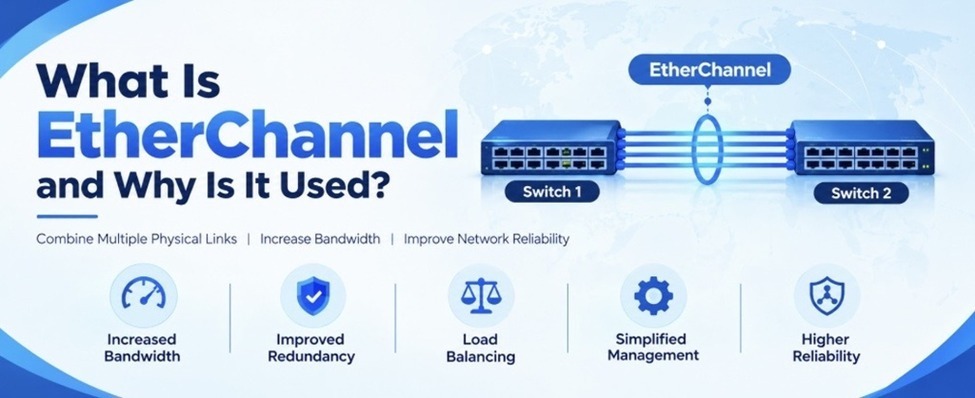
EtherChannel is a Cisco technology that groups multiple physical Ethernet interfaces into one logical interface called a Port-Channel.
Instead of managing each physical link separately, network devices can treat the group as one logical connection.
For example, multiple 1-Gbps links between two switches can be combined into an EtherChannel to provide greater aggregate bandwidth and redundancy.
How Does EtherChannel Work?
EtherChannel creates a logical connection by bundling multiple physical interfaces together.
Traffic is distributed across the available physical links using a load-balancing algorithm. The exact method can depend on the network device and configuration.
If one physical link fails, the remaining links in the EtherChannel can continue carrying traffic. This helps maintain connectivity and reduces the impact of individual link failures.
Why Is EtherChannel Used?
- Increased Bandwidth
Multiple physical links can provide greater aggregate network capacity. This is useful for high-traffic connections between switches, servers, and other network devices. - Improved Redundancy
EtherChannel provides multiple physical paths. If one member link fails, the remaining links can continue forwarding traffic, improving network availability. - Load Balancing
EtherChannel can distribute different traffic flows across its physical member links. This helps utilize available network capacity more efficiently. - Simplified Management
Multiple physical interfaces are managed as a single logical Port-Channel. This can simplify configuration, monitoring, and network administration.
EtherChannel Protocols
Cisco networks commonly use LACP and PAgP for EtherChannel negotiation.
• LACP (Link Aggregation Control Protocol): An industry-standard protocol used to negotiate link aggregation.
• PAgP (Port Aggregation Protocol): A Cisco-proprietary protocol used to form EtherChannel.
EtherChannel can also be configured using a static on mode without negotiation.
EtherChannel and STP
EtherChannel also works with Spanning Tree Protocol (STP) by presenting the bundled physical links as a single logical link.
This allows multiple physical connections to be used together while helping prevent Layer 2 network loops.
Key Benefits of EtherChannel
EtherChannel provides several important benefits:
• Increased Bandwidth
• Improved Redundancy
• Load Balancing
• Simplified Management
• Higher Network Reliability
These features make EtherChannel useful in enterprise and data-center networks where reliable and high-capacity connectivity is required.
Conclusion
EtherChannel is an important networking technology that combines multiple physical Ethernet links into one logical connection. It helps organizations increase bandwidth, provide redundancy, distribute traffic, and simplify network management.
Understanding EtherChannel, LACP, PAgP, load balancing, and its relationship with STP is an important part of building strong enterprise networking skills.