How Does BGP Work in Large-Scale Enterprise and Service Provider Networks?
Introduction
Border Gateway Protocol (BGP) is the routing protocol used to exchange routing information between different autonomous systems (ASes). It plays a critical role in large-scale enterprise networks, Internet Service Provider (ISP) networks, and the global Internet.
Unlike interior gateway protocols such as OSPF and EIGRP, which are primarily designed for routing within an organization, BGP is designed to handle routing between independent networks while providing extensive control over how traffic enters and leaves a network.
What Is BGP?
BGP is a path-vector routing protocol. Instead of simply selecting a route based on metrics such as bandwidth or cost, BGP considers attributes and the AS path through which a destination can be reached.
For example, an enterprise network may connect to multiple service providers:
Enterprise Network → ISP 1 → Internet
Enterprise Network → ISP 2 → Internet
BGP allows the enterprise to advertise its network prefixes to the providers and learn routes from them.
How Does BGP Work?
BGP routers establish a TCP connection using TCP port 179. After establishing a BGP session, the routers exchange routing information and use BGP attributes to determine which routes should be installed and advertised.
A simplified BGP process is:
- BGP neighbors establish a TCP session.
- They exchange BGP messages.
- Each router advertises reachable network prefixes.
- BGP evaluates available paths using its routing policies and attributes.
- The selected routes are installed in the routing table.
- Routes can then be advertised to other BGP neighbors.
eBGP and iBGP
BGP is commonly divided into two types:
eBGP (External BGP)
Used to exchange routes between different autonomous systems, such as an enterprise and an ISP.
iBGP (Internal BGP)
Used to distribute BGP-learned routes between routers within the same autonomous system.
For example:
ISP 1
|
eBGP
|
Enterprise
AS 65001
|
eBGP
|
ISP 2
Inside the enterprise, iBGP can distribute externally learned routes between BGP-speaking routers.
Important BGP Attributes
BGP provides detailed control over route selection through attributes. Common attributes include:
• AS_PATH – Records the autonomous systems a route has passed through and helps prevent routing loops.
• LOCAL_PREF – Used within an AS to influence the preferred outbound path.
• MED – Can be used to influence which entry point another AS prefers, when applicable.
• NEXT_HOP – Identifies the next-hop address for reaching a destination.
• COMMUNITY – Allows routes to be grouped and policies to be applied efficiently.
These attributes allow network engineers to implement traffic-engineering policies rather than relying only on shortest-path calculations.
BGP in Large-Scale Enterprise Networks
Large enterprises may use BGP when they have:
• Multiple Internet connections
• Multiple data centers
• Cloud connectivity
• WAN connections across different providers
• Redundant network paths
• Public IP address prefixes
For example, an enterprise with two Internet providers can use BGP to provide path redundancy.
If one provider becomes unavailable, BGP can withdraw the affected routes and traffic can use an alternative path, depending on the configured routing policy and available routes.
BGP in Service Provider Networks
Service providers operate networks containing large numbers of routers, customers, and routing prefixes. BGP is fundamental to their operation.
Service providers can use BGP to:
• Exchange routes with other providers
• Connect enterprise customers
• Exchange Internet routes
• Implement routing policies
• Support VPN services
• Connect geographically distributed networks
Large providers also commonly use BGP in technologies such as MPLS Layer 3 VPNs and other service-provider architectures.
BGP Route Exchange
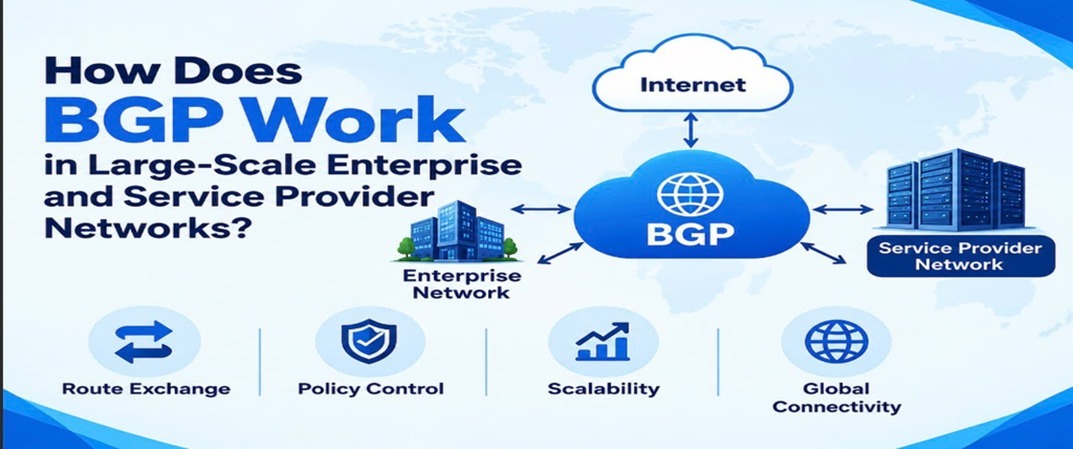
The image illustrates an important concept: BGP connects enterprise networks, service-provider networks, and the Internet.
A simplified model looks like this:
Internet
|
BGP
/
/
Enterprise Network Service Provider
Network Network
BGP enables these independent networks to exchange information about which IP prefixes they can reach.
BGP and Scalability
One of BGP’s major strengths is its ability to operate at Internet scale.
Instead of requiring every router to know every possible physical path through every network, BGP exchanges reachability information and applies routing policies to determine usable paths.
This makes BGP suitable for environments where thousands or even hundreds of thousands of prefixes may need to be handled.
BGP and Policy Control
BGP is not simply about finding a route. It is also about controlling which routes are preferred and which routes are advertised.
For example, an enterprise could configure routing policies so that:
• Provider A is preferred for outbound Internet traffic.
• Provider B acts as a backup.
• Specific prefixes use a particular provider.
• Certain routes are not advertised to a particular neighbor.
This policy-based approach is one of the key reasons BGP is widely used in large networks.
BGP and Global Connectivity
The Internet is made up of thousands of independently operated networks called Autonomous Systems. BGP provides the mechanism that allows these networks to exchange reachability information.
When a network announces an IP prefix through BGP, other networks can learn how to reach that prefix and potentially propagate that information further according to their policies.
This creates the interconnected routing system that enables global Internet connectivity.
Conclusion
BGP is a fundamental technology for large-scale enterprise, service-provider, and Internet networks. Its ability to exchange routing information between autonomous systems, apply sophisticated routing policies, provide redundancy, and scale to very large routing tables makes it different from traditional internal routing protocols.
For network engineers, understanding eBGP, iBGP, BGP attributes, route selection, route advertisement, and routing policies is essential when working with large enterprise or service-provider environments.