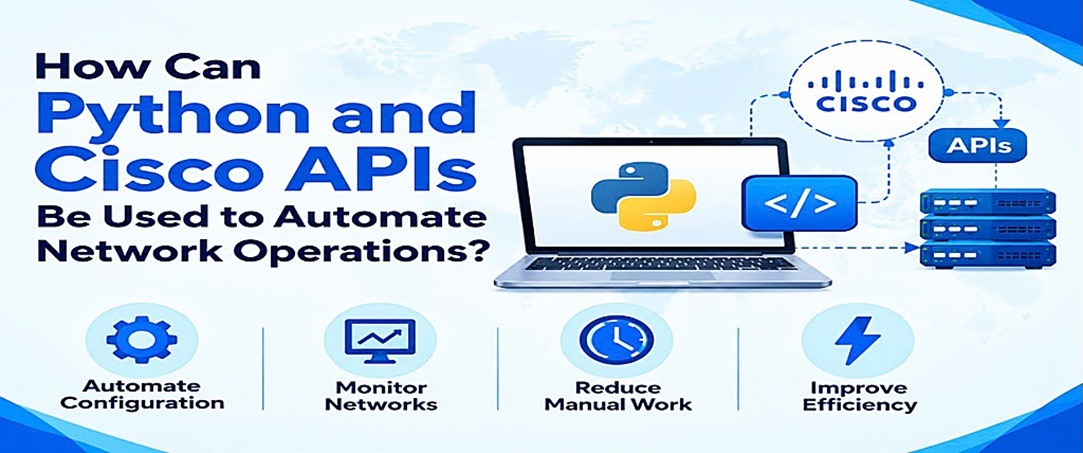
How Can Python and Cisco APIs Be Used to Automate Network Operations?
Introduction
Modern networks are becoming increasingly large and complex. Manually configuring routers, switches, firewalls, and other network devices can take significant time and can introduce configuration errors. Network automation helps engineers perform repetitive tasks consistently and efficiently.
Python and Cisco APIs provide a powerful combination for automating network operations. Python supplies the programming and automation logic, while Cisco APIs provide programmatic access to network devices and management platforms.
Why Automate Network Operations?
Traditional network management often requires engineers to log in to individual devices and execute commands manually. This approach becomes difficult when an organization manages hundreds or thousands of devices.
Automation can help organizations:
• Reduce repetitive manual configuration work
• Improve configuration consistency
• Reduce the risk of human error
• Monitor networks more efficiently
• Speed up operational tasks
• Standardize network changes across many devices
What Is Python in Network Automation?
Python is a widely used programming language for network automation because it has a large ecosystem of libraries and tools for working with network devices, APIs, data formats, and automation platforms.
A Python automation script can connect to network devices, collect information, make configuration changes, process API responses, and generate reports.
What Are Cisco APIs?
Cisco APIs are interfaces that allow applications and automation tools to communicate programmatically with Cisco products and platforms. Instead of relying only on manual command-line interaction, an application can send requests to an API and receive structured data in response.
Depending on the Cisco platform, APIs can be used for tasks such as:
• Collecting device and network information
• Managing configurations
• Monitoring network health
• Retrieving operational data
• Creating or updating network resources
• Integrating Cisco systems with other applications
How Python and Cisco APIs Work Together
Python can act as the automation layer between an engineer and the Cisco infrastructure. A typical workflow looks like this:
- Python starts the automation script.
- The script authenticates to the appropriate Cisco API or network device.
- Python sends an API request or automation command.
- The Cisco platform processes the request.
- The platform returns structured information or a result.
- Python processes the response and performs the next required action.
- The script can log the result or generate a report.
Common APIs and Automation Approaches
Cisco environments can expose different interfaces depending on the product and use case. Common approaches include REST APIs, NETCONF, RESTCONF, and controller-based APIs.
REST APIs commonly use HTTP methods such as GET, POST, PUT, PATCH, and DELETE. Data is often exchanged in JSON format, making it convenient for Python programs to process.
NETCONF and RESTCONF can provide structured methods for working with network configuration and operational data, particularly in environments that support model-driven programmability.
Python Libraries for Network Automation
Python provides libraries that can simplify network automation. Depending on the environment, engineers may use tools such as requests for HTTP APIs, Netmiko for CLI-based device connections, or libraries and SDKs provided for specific Cisco platforms.
The choice of library depends on the device, API, authentication method, and automation objective.
Example: Automating Device Information Collection
Suppose an organization needs to collect information from many Cisco devices. Instead of connecting to each device manually, a Python script can connect to the required API or management interface, retrieve the information, and store the results.
For example, an automation workflow could collect:
• Device hostname
• Management IP address
• Software version
• Interface status
• CPU or memory information
• Routing or operational data
The results can then be stored in a database, CSV file, dashboard, or monitoring system.
Example: Automating Configuration Changes
Automation can also be used when the same configuration needs to be applied to multiple devices. A Python program can read a list of target devices, authenticate to each system, apply the required configuration through an appropriate interface, and record whether the operation succeeded.
This approach can significantly reduce the repetitive work involved in large-scale network changes.
Monitoring Networks with Automation
Python and APIs can be used for continuous or scheduled monitoring. An automation script can periodically retrieve operational data and check for conditions that require attention.
For example, an organization can automate checks for:
• Interface failures
• Device availability
• High resource utilization
• Configuration changes
• Routing problems
• Other operational conditions exposed by the platform
Security Considerations
Network automation must be designed with security in mind. API credentials and device access should be protected, and automation accounts should receive only the permissions they require.
• Use secure authentication methods
• Protect API credentials and secrets
• Use HTTPS where supported
• Apply least-privilege access
• Validate inputs before making changes
• Log automation actions and results
• Test changes before deploying them broadly
Benefits of Python and Cisco API Automation
• Automation – Repetitive tasks can be executed programmatically.
• Monitoring – Network information can be collected quickly and consistently.
• Reduced Manual Work – Engineers spend less time performing repetitive operations.
• Improved Efficiency – Large numbers of devices can be handled through standardized workflows.
• Consistency – The same logic can be applied across multiple devices and environments.
• Scalability – Automation workflows can grow with the size of the network.
Conclusion
Python and Cisco APIs provide a practical foundation for modern network automation. Python can handle the logic, data processing, validation, and workflow orchestration, while Cisco APIs provide programmatic access to supported network platforms and services.
By combining these technologies, network engineers can automate configuration, monitoring, information collection, and operational workflows. As enterprise networks continue to grow, API-driven automation can help teams manage infrastructure more consistently and efficiently.